
The Geopolitical Risk Premium: How Alliance Structures Drive Energy Procurement Costs
By Darija Maraš
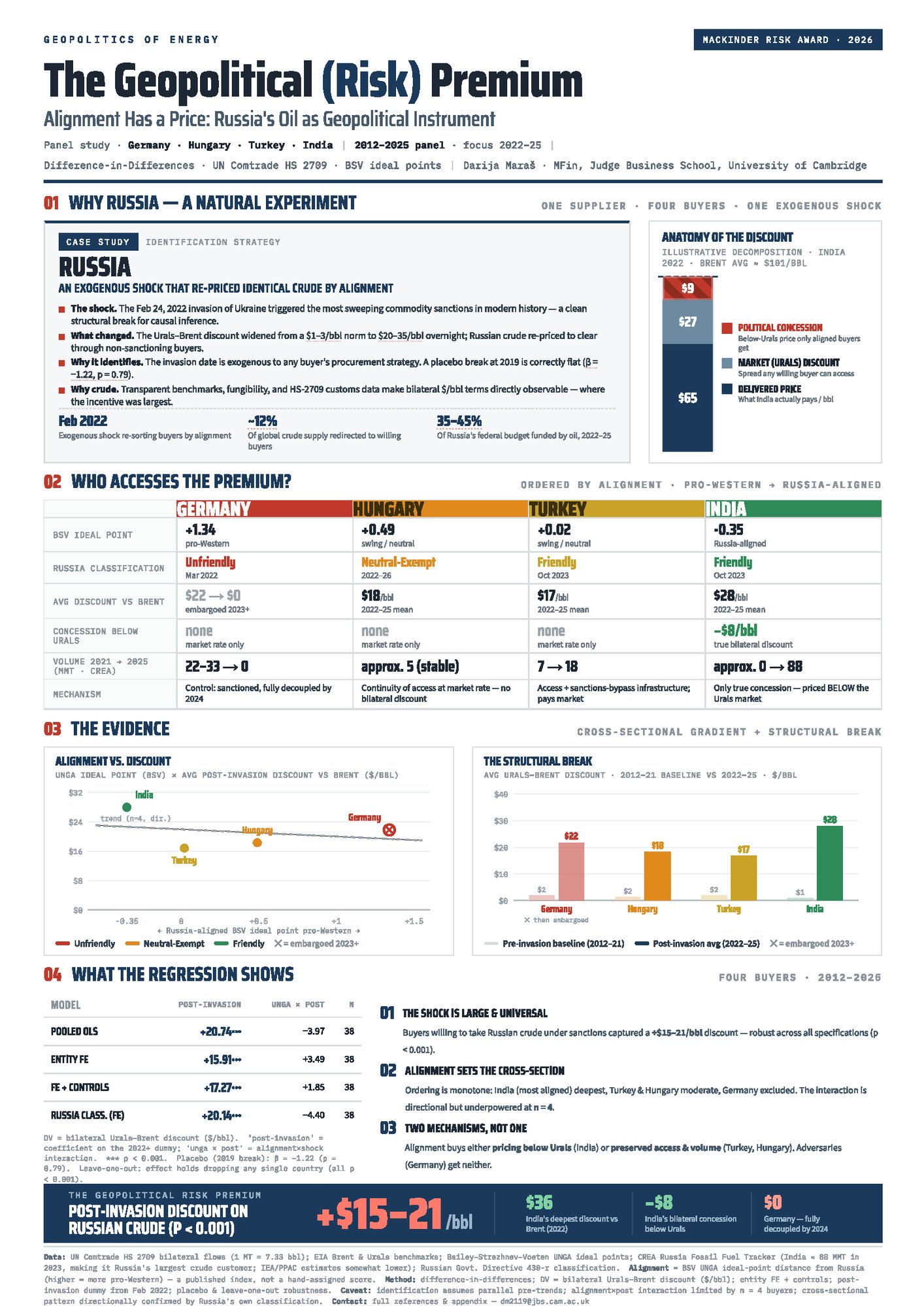
Presentation Abstract
Does political alignment with Russia earn a country a cheaper barrel?
Since 2022, importers of Russian crude have paid very different prices, and this study asks how much of that gap is genuinely (geo)political rather than just the going rate for taking on sanctioned oil. Using a difference-in-differences design across four cases:
Germany*, Hungary, Turkey, and India, each buyer's discount was benchmarked twice. The comparison to Brent captures the full "access" discount available to anyone willing to transact at all. The second benchmark, Urals, strips that away and isolates the (geo)political slice on top. The gap between the two is where alignment shows up. India is the clearest case, as it saved roughly $65bn against Brent over 2022–25 period, with about $18bn of that being genuinely (geo)political. The method travels beyond oil. Wherever a geopolitical question leaves a mark on a transparent price, the same approach can put a dollar figure on it.
*Germany opted out of buying Russian oil in 2022, data used as pre-2022 dynamic comparison.
About the Author

Darija Maraš is a Master of Finance candidate at the University of Cambridge (Judge Business School), where she participated in the Geopolitical Risk Analysis Study Group and competed for the 2026 Mackinder Geopolitical Risk Award. Her path into finance runs through geopolitics: after a History degree and MA in Geopolitical Studies (published with Taylor & Francis), she spent two years in primary bond issuance at Clearstream (Deutsche Börse Group), followed by a
portfolio-management role. She intends to continue her professional development on emerging-markets desks, where sovereign credit, FX, and political risk are priced together rather than in isolation, a space her background in both primary debt markets and geopolitics is built for.