Friends with Bombs: How America's Allies Are Becoming the Real Proliferation Risk
By Tom Makins
Presentation Abstract
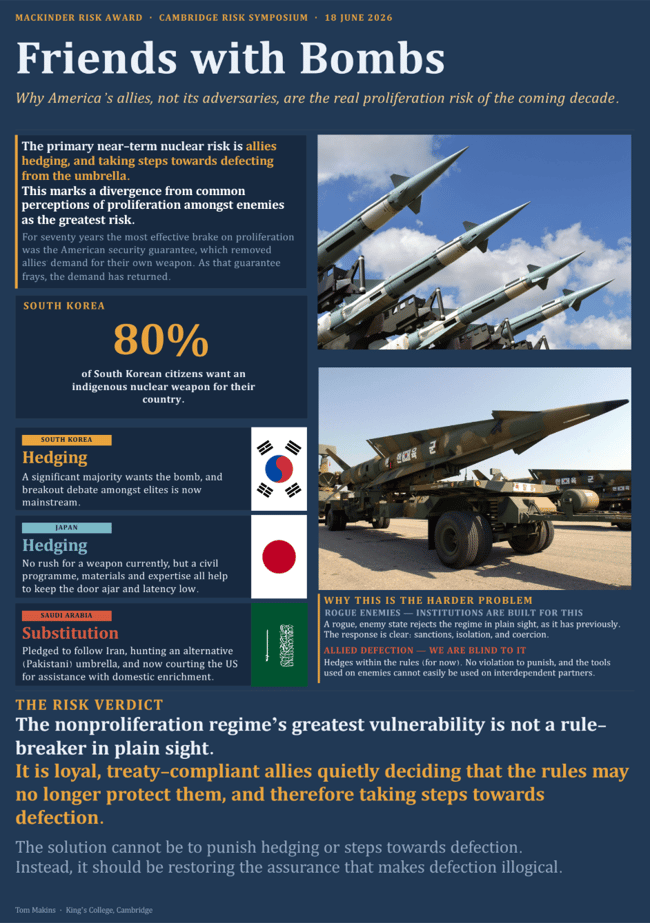
Friends with Bombs argues that the most consequential near-term threat to the nuclear nonproliferation regime comes not from adversaries racing for a weapon, but from America's own treaty-compliant allies.
Drawing on demand-side theory of nuclear inhibition, the project contends that the single greatest brake on proliferation since 1945 has been the American security guarantee, which suppressed allies' demand for independent arsenals rather than merely denying them the capability. As confidence in extended deterrence erodes, that demand returns. The risk it identifies is not a sudden dash for the bomb, but rather allied hedging within the rules, such as enriching under safeguards, deepening latent capability, and compressing breakout timelines until defection becomes a short and inexpensive step.
Three cases trace the mechanism across different triggers. South Korea, the central case, shows record and condition-resilient public support for an indigenous weapon alongside a now-mainstream elite breakout debate. Japan illustrates the textbook hedger, holding the door to nuclearisation deliberately ajar. Saudi Arabia demonstrates that the logic generalises beyond America's Asian treaty allies.
The work concludes that this "friendly proliferation" is categorically harder to manage than the rogue scenario, because hedging presents no clean violation to punish, and is immune to the coercive tools built for adversaries, while one ally's defection invites the next. The task of nonproliferation this decade, it argues, is therefore less about punishing defection than about restoring the assurance that once made defection unthinkable.
About the Author

Tom Makins is a graduate of the University of Cambridge, where he read Human, Social, and Political Sciences at King's College, specialising in Politics and International Relations. His interests span international security and the politics of the world economy, including energy and green-transition geopolitics, nuclear strategy, and the future of warfare. He works in an analytical, evidence-driven register, drawing on international relations theory and political economy to trace how shifting geopolitical dynamics translate into concrete, near-term risk.
He was awarded the 2026 Mackinder Risk Award for "Friends with Bombs," a study arguing that the most consequential near-term proliferation risk comes not from adversaries but from America's own treaty-compliant allies, as confidence in the American security guarantee erodes and states begin to hedge toward a nuclear arsenal. Alongside his degree, he took part in a research-based geopolitical risk study group with the Cambridge Centre for Risk Studies, and he previously interned at Korn Ferry in organisational strategy.
Beyond his academic work, Tom was a keen rower and served as Men's Captain of King's College Boat Club, which under his leadership fielded more crews than at any time in the previous fifteen years and enjoyed considerable success on the water.
He is now looking to build a career in the geopolitical risk field, where he hopes to bring rigorous, applied analysis to the political and economic uncertainties facing governments, investors, and organisations.